


 DVM Goran Tomišić1, DVM Olgica Derota1, DVM Davor Ninković2
Veterinary clinic Tommy1, Veterinary clinic Radionica2, Belgrade, Serbia
Introduction
On the basis of long term use of continuous infusion of fentanylindifferent orthopedic procedures (pelvic, front and hind leg fractures, cruciate ligamentrepair and spinal surgery), we wanted toexplore the effects ofremifentanil, considering that they belong to the same group of opioid analgesics. Moreover,remifentanil is not widely used as fentanil in small veterinary practice. All surgical interventions were performed underisoflurane general anesthesiaandpremedication with medetomidine (intwenty six cases) and acepromazine (in sixteen cases). All patients were in good general condition (28 dogs and 14cats), age of six months toten years with no history of other diseases. Analgesic effect of remifentanil was extremely powerful and has directly decreased isoflurane MAC. Based on ourresultswe can concludethatremifentanilis powerfulanalgesicwith very short duration.
Based on the extended use of continuous infusion with the syringe pump of fentanyl (CRI) in different orthopedic procedures, the effects of clinical efficacy ofremifentanilas analgesic for these procedures which are very demanding in terms of analgesia. Surprisingly, given that they belong to the same group of the opioid analgesics, we have expected to obtain similar results to the effect of analgesia, side effects and speed of recovery from anesthesia. In fact, the continuous application in adminstering the drug has created remarkable savings in the reduction of the quantities used, as opposed to either timed dosage of remifentanil or the classic or CRI fentanyl application.
Materials and Methods
During surgery wewere not able to use artificial ventilation under general anesthesia. Each patient has received premedication with atropine at a dose of 0.02-0.05 mg/kg with the aim of prevention of bradycardia.Furthermore, the premedicationdrugs used, weremedetomidine at a dose of 10mcg/kg (0.01 ml/kg) for dogs and 50 mcg/kg (0.05 ml/kg)for cats and acepromazinefor both dogs and cats, at a dose of 0,06 mg/kg. Propofol was used for induction in a range from 1 to 4 mg/kg.After intubation was administered, continuous infusion of remifentanil which was followed by a significant decrease in the percentage of the isoflurane anesthetic in the range of
0.5% to 1,5 %.The dose of CRIremifentanil was in a range from0.4 to 0.1 mcg /kg /min, which is comparable to the recommended dose of fentanyl is 0.2 mcg /kg /min.During anesthesia monitoring analgesia was continuously matched to the frequency of heart rate, frequency and volume of respiration, arterialblood pressure and oxygenation of tissues(4).Forty two different orthopedic operations were carried out under this anesthetic protocol without visibleproblems on monitored parameters.
Results
 The tables(Table 1. and Table 2.) show the varying concentration of Isoflurane in CRI administered remifentanil vs fentanyl.
In 28 dogs, the remifentanil dosage from 0.1 to 0.4mcg/kg/min (M=2.357, SD=1.062). Average concentration of Isofluranebeing 1.036% (M=1.036, SD=.470).
In 18 cats, at the same dosage level of remifentanil gave 0.92% of isoflurane (M=.920, SD=.275).
In comparison with our previous experiences with fentanyl (dosage being 0.2 mcg/kg/min, M=2.000, SD=.000), that was averaging 1.4% isoflurane in 30 dogs (M=1.400, SD=.000) to 1.2% isoflurane in 16 cats (M=1.200, SD=.000), the usage of remifentanil gives 0.37% (t=-4.248, df=56, py0.01) lower consumption of isoflurane in dogs and 0.28% (t=-4.067, df=29, p<0.01) in cat.
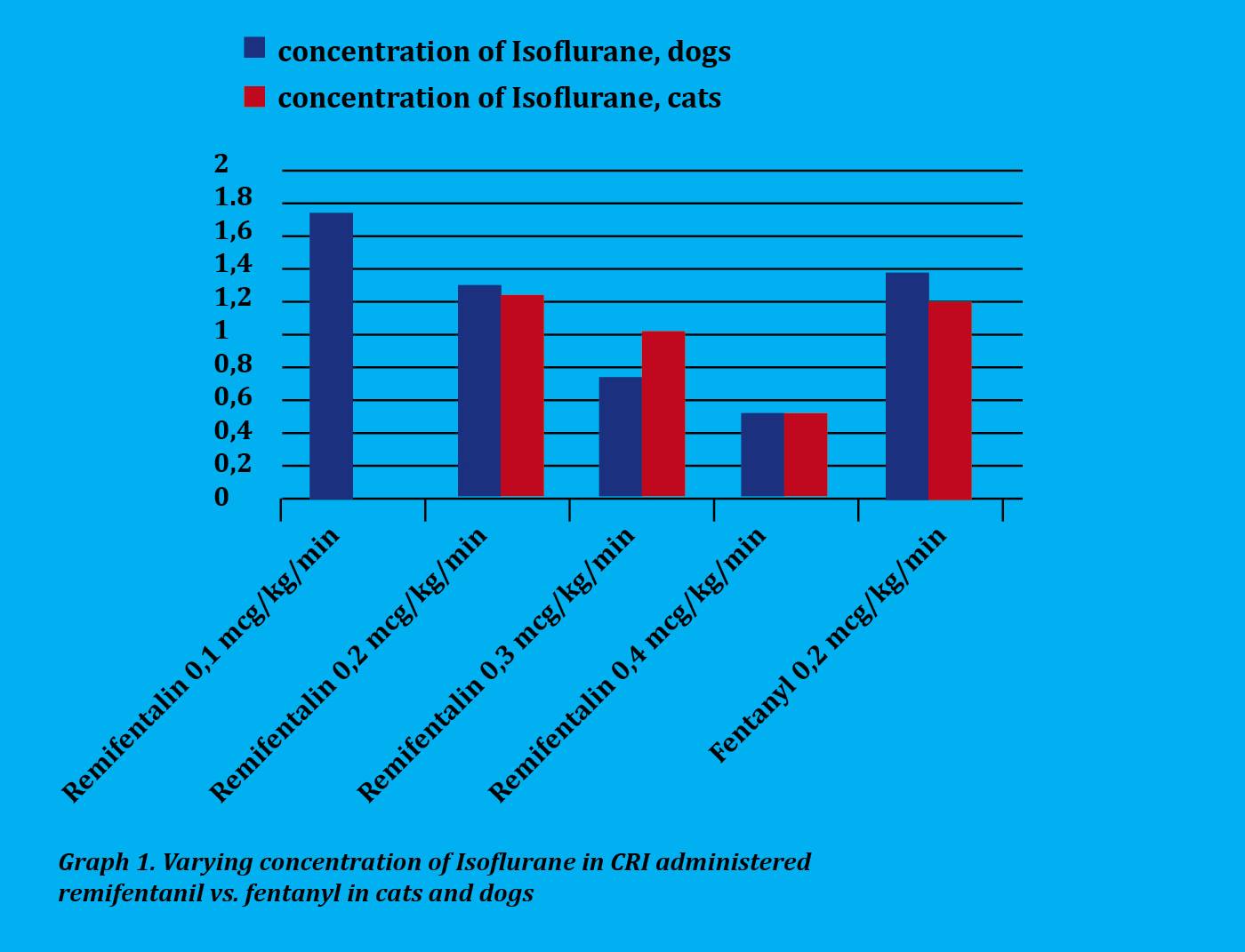 The effect of analgesia was markedly potent, having direct impact on the decrease ofisoflurane in 60 % of MAC|(1). Recovery is easy and tree times as fast than if we had used fentanyl. The length of the surgical procedure did not affect the stability of the patient. When we used remifentanil CRI with propofol for induction of anesthesia, nausea and vomiting were nearly non-existent. In addition to the low frequency heart rate,there were no significant hemodynamic changes in the circulation. In some (11 dogs) patients, mild defecation was observed.

